


This post may contain affiliate links. If you buy something through a link here, we’ll get a kickback at no extra cost to you. Wake + Bake is entirely supported by readers like you and we only recommend products we’ve tested and love. Thank you for your support!
In this guide
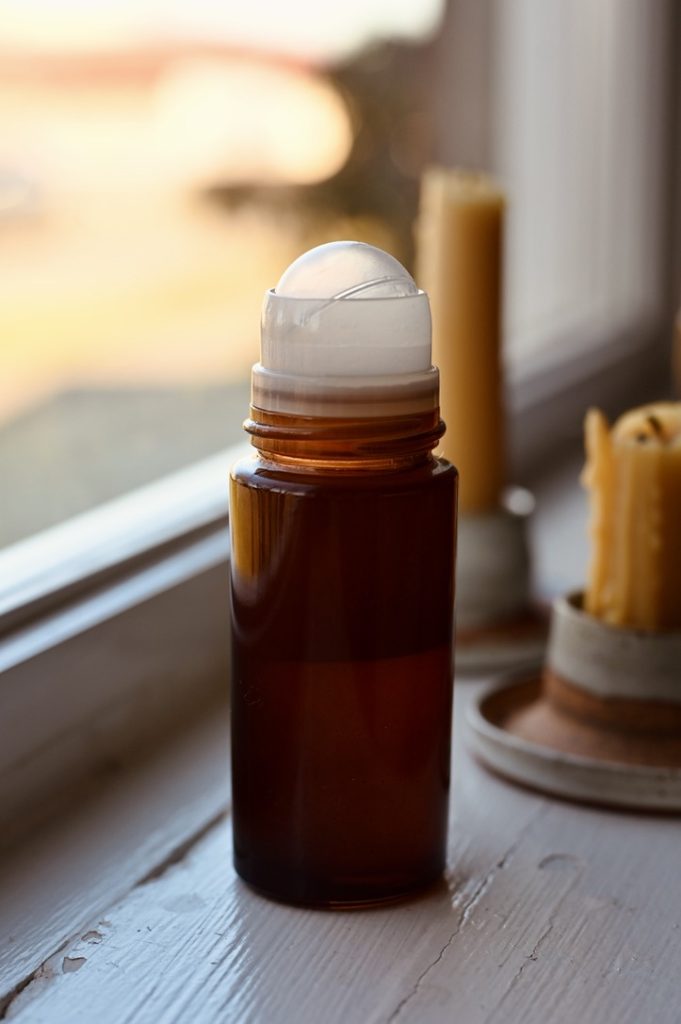
A CBD roll-on is CBD-infused oil mixed with essential oils and poured into a roller bottle, so you can rub it into a sore spot without getting oil all over your hands. This one is mine, the Roller Doobie. It’s ½ cup of CBD-infused MCT oil and five essential oils, and it fills two 50 ml roller bottles with a little left over.
Some of the product links in this post are affiliate links. If you buy through one, it supports this project at no extra cost to you. There’s no pressure to ever buy anything using these links, but if you do, I deeply appreciate your support. Thank you.
From my cookbook, Highly Medicinal.
I know I’ve said this about other recipes, but seriously, this one is my favorite. The Roller Doobie started as a secret tester recipe in my community, and people loved it right away.
It’s part massage roller, part topical applicator, and small enough to carry anywhere. Swap in whatever essential oils you like, or build a blend for the spot that bugs you most. It’s my go-to for neck tension, lower back pain, and shoulder knots, and the best part is no greasy hands.
Peppermint and clove are why you feel it the second it hits your skin. Some people have reported putting menthol in as well to give it even more oomph.

What you need to make a CBD roll-on
The CBD oil base
The base for this recipe is CBD-infused MCT oil. You can also use olive oil if you prefer. Both of them are great at extracting cannabinoids.
Either one stays liquid at room temperature, which matters in a roller. Coconut oil goes solid below about 76°F, and a rollerball full of it won’t budge on a cold morning.
If you don’t have infused oil on hand yet, the whole process is in How to Make CBD Oil at Home.
The essential oils
I chose five essential oils and split them between cooling and warming. Peppermint and eucalyptus are cool and invigorating, and they have muscle-soothing properties on their own.
The warmth comes from clove, black pepper and ginger, which are also known to reduce inflammation.
Ginger is expensive, so it’s optional. If you’re keeping it on a budget, leave it out. If you have it on hand, it does make it next level.
Which roller bottles are best for a CBD roll-on?
My favorite roller bottles are these. I’ve been testing them for two years now.
Amber glass keeps light off the oil, and glass holds up to essential oils better than thin plastic.
Half a cup is about 118 ml, which fills two of these 50 ml bottles with a little left over. If you’d rather have something pocket-sized, the same batch fills about eleven standard 10 ml rollers.
How strong is a homemade CBD roll-on?
It depends entirely on your infused oil. Divide the milligrams of CBD in your ½ cup of oil by 118 and you have milligrams per ml. A 50 ml bottle holds 50 times that. If the batch of oil carries 1,000 mg, each 50 ml roller holds about 425 mg.
Store-bought roll-ons run anywhere from about 150 mg to 2,000 mg a bottle, and the bottles aren’t the same size, so milligrams per ml is the only fair comparison. The dosage calculator works out the total for your batch from the percentages on your flower label.
Essential oil dilution and skin safety
At roughly 30 drops per ml, 200 drops of essential oil in ½ cup of carrier comes out to about 5% essential oil overall. That’s the high end of what aromatherapy references use, and it’s meant for one sore spot at a time, not your whole body.
Clove is the strongest of the five. Robert Tisserand and Rodney Young’s Essential Oil Safety, the standard reference, puts the maximum for clove on skin at 0.5%, and 40 drops in this batch works out to about 1%. If your skin is sensitive, 20 drops of clove brings it to about half a percent.
- Patch test first.
- For the love of all things holy, keep this away from your eyes and off your mucous membranes. Peppermint and eucalyptus both sting.
- Clove, peppermint and eucalyptus all carry cautions for young children and during pregnancy in Tisserand and Young.
- Clove can slow blood clotting, so it’s worth asking a doctor or pharmacist if you take a blood thinner.

Roller Doobie (DIY CBD Roll-On)
Equipment
- Small bowl
- 50 ml amber glass roller bottles
- Labels
Materials
- ½ cup CBD-infused MCT oil
- 40 drops eucalyptus essential oil
- 40 drops clove essential oil
- 40 drops peppermint essential oil
- 40 drops black pepper essential oil
- 40 drops ginger essential oil optional, but amazing. Can sub extra drops of the others if you’re keeping it budget-friendly
Instructions
- In a small bowl, add ½ cup of infused MCT oil.
- Mix in the essential oils, adjusting amounts to suit your sensitivity and scent preferences.
- Stir until fully combined.
- Test a small patch on your skin to make sure it feels good. Adjust oils if needed.
- Pour into reusable roller bottles and label clearly.
Notes
Does topical CBD work?
What we know about CBD topicals is that people love them, and most of that is through anecdote.
I like to call it anecdata, and I don’t ever dismiss people’s experience, even if we don’t have the data to back it up.
People are buying tons of CBD topicals. Grand View Research puts CBD skincare alone at about $2.9 billion worldwide.
The research hasn’t caught up. There just isn’t a whole lot of it, but here’s what we do know.
The best result so far is a 2022 randomized trial at the University of Virginia. Eighteen people with thumb arthritis used 1 ml of shea butter carrying 6.2 mg of CBD per ml, twice a day, and reported less pain and better hand function than the group using plain shea butter, with no side effects.
That concentration is in the same range as this roller. If your ½ cup of infused oil carries 1,000 mg, the Roller Doobie works out to about 8.5 mg per ml.
Project CBD has a good roundup of where the science stands, if you want to stay up to date on it.
Why a roller is the best way to use a CBD topical
If you’re already using CBD topicals, a roller is the best delivery method. You don’t get your hands dirty, and it fits in a pocket or a bag. It’s made for a small spot you want to hit fast and often: the back of the neck, a shoulder blade, a knee, a wrist after a day on the keyboard.
A salve is thicker and stays put, which makes it better on dry, cracked skin. Massage oil is the one for a whole back, especially when somebody else is doing the rubbing. If you like this one, my CBD massage oil recipe has been well tested by readers, and you can use a whole lot more of it.
Can you make it with THC oil?
Yes, if cannabis is legal where you live. Swap the CBD-infused MCT for THC-infused MCT and the method is identical. Topicals like this one stay local and don’t get you high, because very little cannabinoid makes it through the skin into your blood.
Transdermal patches and gels are a different story. They’re built with penetration enhancers whose whole job is getting it into the bloodstream.
How long does a homemade CBD roll-on last?
As long as the oil you made it with. MCT is almost entirely saturated fat, so it resists going rancid far better than olive or hemp seed oil. Keep the bottles somewhere cool and out of direct sun, and give each one a sniff before you use it. Rancid oil smells like old crayons, and the essential oils won’t fully cover it.
More CBD topicals
Let me know in the comments below if you made it. I hope you love it.
With love,
CT
Make this next


The cookbook
Everything you need to become your neighborhood’s favorite cannabis kitchen witch
Over 75 recipes, and the tutorials that get you edibles that taste good, feel good, and make you a legend.
